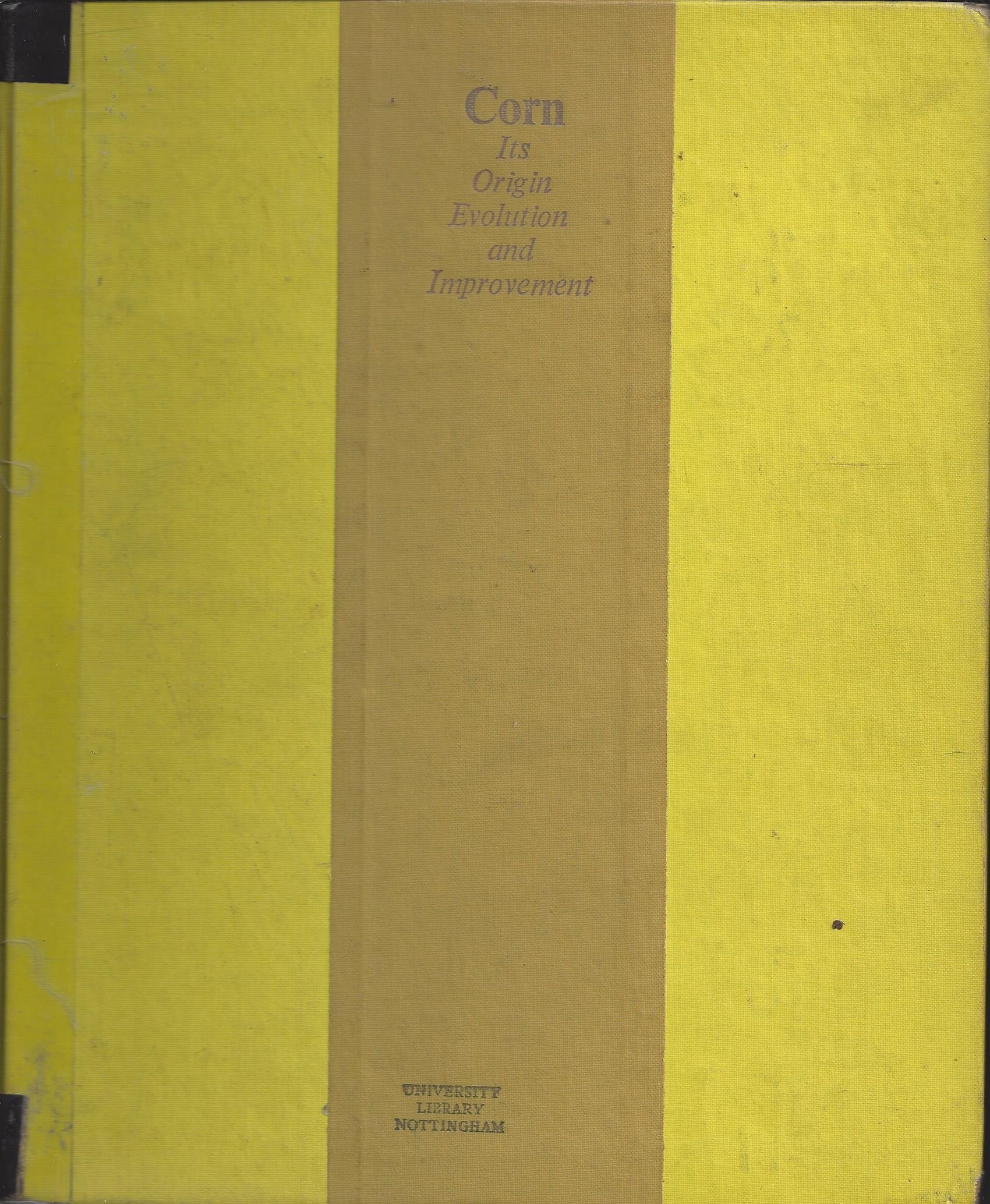
Corn: Its Origin, Evolution and Improvement (Belknap Press)
Corn: Its Origin, Evolution and Improvement (Belknap Press)
 |
READ or DOWNLOAD NOW
Corn is among the most familiar of grains it is also one of the most mysterious. In this handsomely illustrated new book, Paul Mangelsdorf, perhaps the world's foremost expert on the corn plant, summarizes the work of a lifetime devoted to unraveling the enigma of corn. This unique grain--it has no close counterpart elsewhere in the plant kingdom--exists only in association with man, and it survives only as a result of his intervention. Thus, the story of corn is in many ways a story about people. Combining the skills of scientist and storyteller, Professor Mangelsdorf in his search for the origin of corn takes the reader to archaeological digs in once-inhabited caves in Mexico and the United States Southwest, to the discovery of fossil pollen in drill cores taken deep below Mexico City, and to experimental fields where the great diversity of corn is revealed and where the plant is hybridized with its relatives teosinte and Tripsacum, Drawing upon the evidence from botany, genetics, cytology, archaeology, and history, the author seeks to evaluate various hypotheses on the origin of corn. He concludes that the ancestor of cultivated corn was a wild form of pod corn that corn may have been domesticated more than once in both Mexico and South America from different geographical races of wild corn and that hybridizations between corn and its various relatives have resulted in explosive evolution leading to a diversity of varieties and forms unmatched in any other crop plant. This is a book about corn, but it is a book for biologists, agronomists, anthropologists, and historians, and for the interested layman who would like to know something about the grain which, transformed, as three fourths of it is, into meat, milk, eggs, and other animal products, is our basic food plant, as it was of the people who preceded us in this hemisphere
READING BOOK DOWNLOAD BOOK
1. Mental Stimulation
Studies have shown that staying mentally stimulated can slow the progress of (or possibly even prevent) Alzheimer’s and Dementia,[1] since keeping your brain active and engaged prevents it from losing power.
Just like any other muscle in the body, the brain requires exercise to keep it strong and healthy, so the phrase “use it or lose it” is particularly apt when it comes to your mind. Doing puzzles and playing games such as chess have also been found to be helpful with cognitive stimulation.[2]
2. Stress Reduction
No matter how much stress you have at work, in your personal relationships, or countless other issues faced in daily life, it all just slips away when you lose yourself in a great story. A well-written novel can transport you to other realms, while an engaging article will distract you and keep you in the present moment, letting tensions drain away and allowing you to relax.
3. Knowledge
Everything you read fills your head with new bits of information, and you never know when it might come in handy. The more knowledge you have, the better-equipped you are to tackle any challenge you’ll ever face.
Additionally, here’s a bit of food for thought: should you ever find yourself in dire circumstances, remember that although you might lose everything else—your job, your possessions, your money, even your health—knowledge can never be taken from you.
4. Vocabulary Expansion
This goes with the above topic:
The more you read, the more words you gain exposure to, and they’ll inevitably make their way into your everyday vocabulary.
Being articulate and well-spoken is of great help in any profession, and knowing that you can speak to higher-ups with self-confidence can be an enormous boost to your self-esteem. It could even aid in your career, as those who are well-read, well-spoken, and knowledgeable on a variety of topics tend to get promotions more quickly (and more often) than those with smaller vocabularies and lack of awareness of literature, scientific breakthroughs, and global events.
Reading books is also vital for learning new languages, as non-native speakers gain exposure to words used in context, which will ameliorate their own speaking and writing fluency.
5. Memory Improvement
? Scroll down to continue reading article ?
Become Super Productive with The Full Life Planner
Grab your Full Life Planner to plan your day for maximum productivity and get more done in less time.
Get My Planner
? Scroll down to continue reading article ?
When you read a book, you have to remember an assortment of characters, their backgrounds, ambitions, history, and nuances, as well as the various arcs and sub-plots that weave their way through every story. That’s a fair bit to remember, but brains are marvellous things and can remember these things with relative ease.
Amazingly enough, every new memory you create forges new synapses (brain pathways)[3] and strengthens existing ones, which assists in short-term memory recall as well as stabilizing moods.[4] How cool is that?
If you want to learn more about how to increase brain power, boost memory and become 10x smarter, check out this technique!
6. Stronger Analytical Thinking Skills
Have you ever read an amazing mystery novel, and solved the mystery yourself before finishing the book? If so, you were able to put critical and analytical thinking to work by taking note of all the details provided and sorting them out to determine “whodunnit”.
That same ability to analyze details also comes in handy when it comes to critiquing the plot; determining whether it was a well-written piece, if the characters were properly developed, if the storyline ran smoothly, etc.
Should you ever have an opportunity to discuss the book with others, you’ll be able to state your opinions clearly, as you’ve taken the time to really consider all the aspects involved.
7. Improved Focus and Concentration
In our internet-crazed world, attention is drawn in a million different directions at once as we multi-task through every day.
In a single 5-minute span, the average person will divide their time between working on a task, checking email, chatting with a couple of people (via gchat, skype, etc.), keeping an eye on twitter, monitoring their smartphone, and interacting with co-workers. This type of ADD-like behaviour causes stress levels to rise, and lowers our productivity.
When you read a book, all of your attention is focused on the story—the rest of the world just falls away, and you can immerse yourself in every fine detail you’re absorbing.
Try reading for 15-20 minutes before work (i.e. on your morning commute, if you take public transit), and you’ll be surprised at how much more focused you are once you get to the office.
Additional information: if you find staying focus hard and re trying to improve your focus, it’s possible you’ve been doing it wrong.
8. Better Writing Skills
This goes hand-in-hand with the expansion of your vocabulary:
Exposure to published, well-written work has a noted effect on one’s own writing, as observing the cadence, fluidity, and writing styles of other authors will invariably influence your own work.
In the same way that musicians influence one another and painters use techniques established by previous masters, so do writers learn how to craft prose by reading the works of others.
9. Tranquility
In addition to the relaxation that accompanies reading a good book, it’s possible that the subject you read about can bring about immense inner peace and tranquility.
Reading spiritual texts can lower blood pressure and bring about an immense sense of calm, while reading self-help books has been shown to help people suffering from certain mood disorders and mild mental illnesses.[5]
10. Free Entertainment
Though many of us like to buy books so we can annotate them and dog-ear pages for future reference, they can be quite pricey.
For low-budget entertainment, you can visit your local library and bask in the glory of the countless tomes available there for free. Libraries have books on every subject imaginable, and since they rotate their stock and constantly get new books, you’ll never run out of reading materials.
If you happen to live in an area that doesn’t have a local library, or if you’re mobility-impaired and can’t get to one easily, most libraries have their books available in PDF or ePub format so you can read them on your e-reader, iPad, or your computer screen.
There are also many sources online where you can download free e-books, so go hunting for something new to read!
There’s a reading genre for every literate person on the planet, and whether your tastes lie in classical literature, poetry, fashion magazines, biographies, religious texts, young adult books, self-help guides, street lit, or romance novels, there’s something out there to capture your curiosity and imagination.
Step away from your computer for a little while, crack open a book, and replenish your soul for a little while.


Comments
Post a Comment